Fishing Tips

The following fishing tips listed below are just a few helpful tips to get you out there doing it right and getting the results you are wanting.

This section will be added to and updated throughout the year.

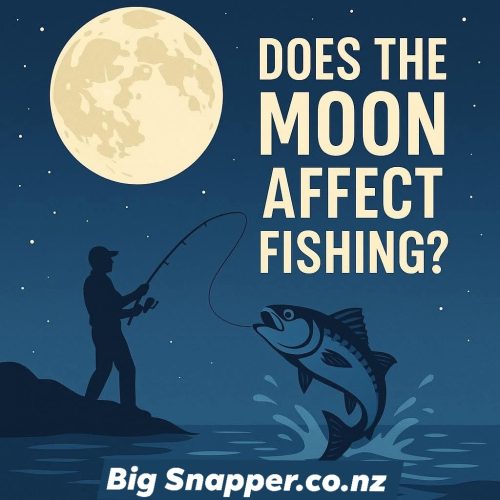
DOES THE MOON REALLY AFFECT FISHING?

Oh yes more than most anglers realize.
The moon doesn’t just light up the night sky; it’s one of the most powerful forces shaping how, when, and where fish feed.
Let’s break it down
The Moon and the Tides — The Engine of Fish Movement
The moon’s gravitational pull drives the rise and fall of tides, which in turn dictates bait movement and predator positioning.
• New Moon & Full Moon = Spring Tides
These are periods of maximum tidal flow. Water moves faster and farther, stirring up nutrients, disorienting baitfish, and triggering predators to feed aggressively.
➜ Expect strong currents, active bait, and heavy strikes perfect for GTs, dogtooth tuna, and other hunters that thrive in chaos.
• Quarter Moons = Neap Tides
Water movement slows down, oxygen levels drop slightly near structure, and fish become more cautious.
➜ It’s a time for finesse and precision smaller lures, slower retrieves, and natural presentations can save the day.
Pro Move: If you’re targeting big GTs or pelagics, align your trip with the new or full moon phases for peak tidal energy.
Moonlight & Feeding Behavior Vision, Shadows, and Opportunity
Fish are visual hunters. The amount of moonlight drastically affects how and when they strike.
• Full Moon:
Bright nights make shallow-water predators more active. GTs, barracuda, and king mackerel use the extra visibility to ambush prey that glows in the moonlight.
However, fish may feed more at night and less during daylight, so plan early-morning or late-evening sessions.
• New Moon:
Darkness hides baitfish, pulling them closer to the surface or shoreline for safety. Big predators follow.
 These are perfect nights for topwater and shore-jigging silent approach, loud explosion.
Hot Tip: If you fish at night, full moon = clear visibility but spookier fish. New moon = stealthier fishing, but more surprise attacks.
Moonrise, Moonset & “Major Feeding Windows”
Every lunar day, there are two major and two minor feeding periods.
Fish often feed hardest around moonrise and moonset even when the tide seems average.
That’s when gravitational forces and subtle current shifts align.
Many pros use lunar tables or apps like Solunar Forecasts to time their casts within these windows.
A 30-minute adjustment can turn a quiet session into pure chaos.
Pro Insight: Combine moonrise/moonset with high tide that’s your double trigger for monster action.
Seasonal & Regional Effects
Not all coasts respond the same way:
• Tropical waters (like the Red Sea) experience stronger tidal amplitude differences during full/new moons ideal for shore-jigging reefs.
• Equatorial regions may have shorter twilight hours, making moonlight more critical for nocturnal feeders.
• Winter months: Fish rely more on lunar light for hunting since days are shorter night fishing becomes even more productive.
Build Your Own “Lunar Fishing Log”
Keep a simple record after each trip:
• Date & moon phase
• Tide height & current speed
• Time of first and last bite
• Water clarity & lure type
After a few months, you’ll start spotting patterns for example:
“GTs smashing stickbaits 2 hours before high tide during waxing moon”
Once you find that rhythm, you’ll fish smarter, not harder.
 Final Thought
The moon doesn’t just move the sea it moves the fish, and if you pay attention, it’ll move your catch rate too.
Master the lunar rhythm, and you’ll stop guessing… and start predicting.

What Are the True “Golden Hours”

What Are the True “Golden Hours” of Fishing and Why Do Fish Feed Aggressively During These Moments?
Every experienced angler knows there are certain moments when the ocean suddenly comes alive baitfish start moving, predators become active, and the entire environment feels different.
These aren’t random spikes. They’re the golden hours of fishing, and they’re far more dynamic than just sunrise and sunset.
Here’s a deeper look at why these windows produce explosive action especially when they line up with the beginning of the incoming tide.
1. Light Transition: Dawn & Dusk
During the hour before and after sunrise and sunset, the ocean goes through a major shift in light. This change triggers:
• Higher baitfish movement
• Reduced visibility for prey
• More surface and mid-water feeding
• Strong predator ambush behavior
Low light gives predators a huge advantage with minimal energy spent.
2. The Power of the Incoming Tide (Beginning of the Tide)
If there’s one tidal moment you should never miss, it’s the first push of the incoming tide.
Why?
• Fresh, oxygen-rich water moves in
• Baitfish get pushed toward structure
• Predators position themselves perfectly along edges
• Water clarity often improves
• Entire food chain becomes more active
The ultimate peak?
Golden hour + beginning of incoming tide = maximum feeding intensity.
Many trophy fish are caught exactly during this overlap.
3. Temperature Stabilization
Around sunrise and sunset, water temperatures settle often becoming cooler and more comfortable for fish.
This encourages predators to:
• Move shallower
• Patrol feeding lanes
• Hunt more confidently near the surface
Cooler water = more activity.
4. Calm Conditions & Better Presentation
Golden hours often come with lighter winds:
• Less surface glare
• Better lure action
• Cleaner presentations
• Higher strike detection
Your lure becomes easier to track and more enticing.
5. Low-Light Predator Advantage
Predators use low light to:
• Camouflage better
• Ambush faster
• Track silhouettes of prey
This is why many anglers get their hardest hits when visibility is low.
So When Should You Fish?
For the best results, target:
✔️ One hour before sunrise
✔️ One hour after sunrise
✔️ One hour before sunset
✔️ One hour after sunset
✔️ And most importantly: the start of the incoming tide especially if it matches one of these times
When these conditions line up, expect chaos. Rods bend, reels scream, and sessions become unforgettable.
SHARPEN YOUR HOOKS

IT MAKES A MASSIVE DIFFERENCE!
Most missed hook-ups aren’t bad luck… they’re blunt hooks.
Every time your hook drags across sand, reef, rocks, shells or even just fights a fish, the tip loses its needle point.
When that happens — you’ll feel the bite, strike… and nothing.
A sharp hook = better penetration and more catching than just fishing.
How to Test if Your Hook is Sharp
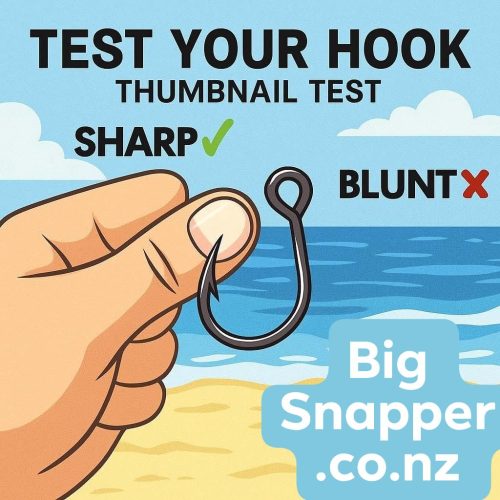
Use the thumbnail test:
1. Hold the hook by the bend.
2. Lightly place the point on your thumbnail (don’t push down).
3. If it catches / grips immediately → Sharp
4. If it slides → Needs sharpening
It takes 3 seconds and can be the difference between stories told and fish landed.
How to Sharpen Your Hook
Use a small hook file or smooth diamond stone:
• Sharpen the point from three sides (left, right, bottom)
• Always angle towards the point
• Don’t overdo it, you want a fine needle, not a chisel
PRO TIP:
Before sliding a bait or making a long cast, check your hook.
You’d be shocked how many bites are lost because the hook was blunt before it even hit the water.
www.bigsnapper.co.nz

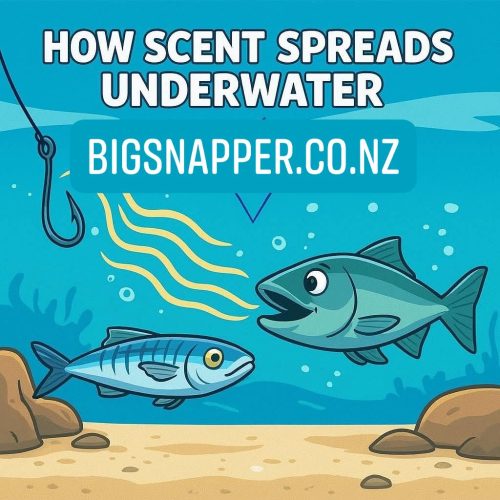
How Scent Spreads Underwater

If you’ve ever wondered why fresh bait works so well as bait… it’s all about the SCENT TRAIL
When oily baits hit the water, they start releasing a natural scent cloud. This scent is carried by currents, drifting along the bottom and through the water column — almost like a breadcrumb trail that leads fish straight to your bait.
Oily baits = stronger scent = more attraction
Mullet & bonito all give off high scent
Predator fish follow these scent trails to investigate
And here’s the key:
Fish don’t only use their eyes to find food — they rely heavily on their sense of SMELL.
In dirty water, at night, or in deep sandbanks, scent is often the #1 way fish find your bait.
Tip:
• Don’t wash your bait in freshwater (it removes the oils).
• Avoid touching your bait after applying sunscreen — unnatural scents can chase fish away.
• If the water is murky or pushing hard, go for a strong-smelling bait — it widens your scent trail.
The bottom line:
If you want fish to find your bait…
Use oily baits. Create scent.
Let the ocean do the calling.

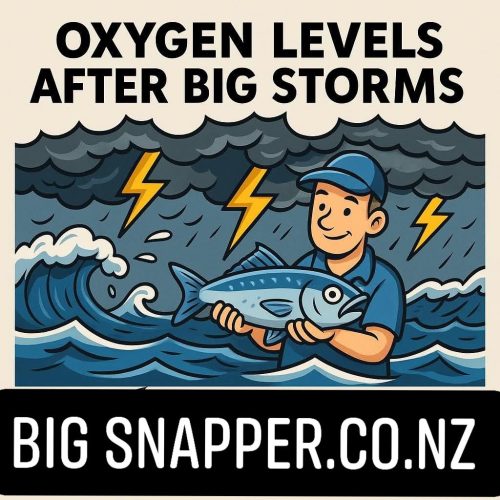
Why Oxygen Levels Matter After Big Waves or Storms

Ever noticed how fishing can go dead quiet right after a big storm even when the water looks perfect?
That’s often because oxygen levels in the surf zone have taken a knock.
When the sea gets churned up by strong winds or big surf:
Sand, silt, and debris get mixed into the water, making it murky and reducing how much oxygen can dissolve.
Freshwater runoff from rivers or rain changes the salinity — and less salt means less oxygen-holding capacity.
Temperature changes can also play a role: warmer water holds less oxygen than cooler water.
Why it matters:
Fish, like us, need oxygen to breathe. When oxygen levels drop, they become sluggish, move deeper, or head for calmer, cleaner areas where the balance returns.
What to look for after storms:
Wait for the water to settle and clear a bit — especially if it looks brown or foamy.
Fish the incoming tide as it brings fresh, oxygen-rich water closer to shore.
Target white-water zones or gutter edges, where wave action naturally oxygenates the water.
Pro tip: Oxygen-rich surf = active fish. When the sea “comes alive” again, so does the bite!
www.bigsnapper.co.nz

Do Fish Hear Noise Above Water?

Let’s settle one of the most common fishing questions
Most anglers know fish are incredibly sensitive to sound and vibration — but do they actually hear your voice, shouting, or talking from the beach or rocks?
Short answer:
No — fish don’t hear airborne sound well at all.
But… they do pick up vibrations, impact noise, and water disturbance extremely well.
Here’s how it works:
How Sound Travels in Water
• Sound moves 4x faster in water than in air.
• Fish don’t have ears like humans — instead they use:
• Their lateral line to detect vibration
• Inner ear bones (otoliths) to sense deeper sound
This makes them incredibly tuned in to vibrations, not voices.
So Can They Hear You Talking?
Not really. Airborne sound reflects off the water’s surface.
Normal talking, shouting, joking with your mates — that sound doesn’t penetrate underwater clearly.
What DOES alert fish?
What Fish Can Detect
Fish pick up:
• Heavy footsteps on rocks, boats or piers
• Rods hitting railings
• Tackle boxes slamming
• Wading or splashing in shallow water
• Dragging anchors
• Boat hull vibrations
• Dropping sinkers or metal on the rocks
These create low-frequency vibrations that travel instantly through water and can spook fish far quicker than your voice ever will.
What This Means for Anglers
If you want to be stealthy:
• Move lightly
• Avoid banging gear
• Keep your footsteps soft
• Don’t throw things into the water
• Anchor quietly
• Don’t splash when wading
Talking with your mates? That’s fine.
Banging your cooler box on the rocks?
That will scare every Kob in the gutter.
www.bigsnapper.co.nz

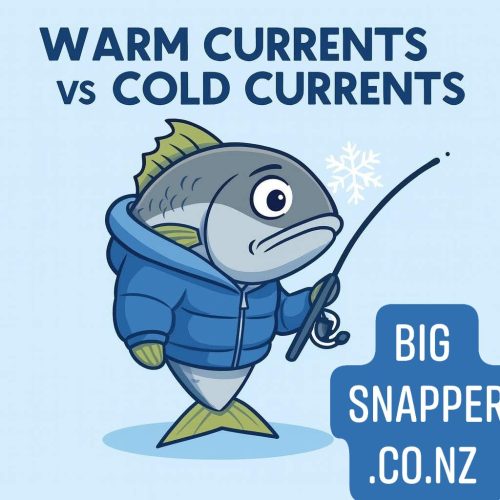
WARM CURRENTS vs COLD CURRENTS

WHY THE FISHING CHANGES OVERNIGHT
Ever had those sessions where the fish were on fire one day and completely vanished the next?
Most anglers blame the moon, tides, or “bad luck” but one of the biggest influencers is water temperature, especially sudden shifts between warm and cold currents.
Here’s why WARM CURRENTS • Bring baitfish, mullet, anchovy and other warm-water species closer to shore. • Predators like, kingfish, bonito, and sharks often follow this food trail. • Warm water boosts metabolism — fish feed more aggressively and move more.
COLD CURRENTS
• Push warm-water species deeper or further north. • Bring cold-water species into their comfort zones. • Can make it go quiet for a day or two until temps stabilise. • Cold upwelling brings nutrient-rich water, great for long-term fishing, but tough for immediate bite.Why the sudden change?
Currents can shift overnight due to: • Strong winds • Swells or storms • Pressure systems • Seasonal changes • Localized upwelling around points or reefs
Even a 2–3°C drop can shut down warm-water feeders completely.
How to use this to your advantage: • Check temperature charts before fishing • Look for warm “pockets” of water after cold spells • Target sandbanks and gutters where warm water settles • Switch species depending on temp changes • Know your fish: some thrive in warm, others in cold
When you understand currents, you understand why the ocean behaves the way it does and suddenly, your fishing becomes a lot more predictable.

STRIKING vs LETTING THE FISH LOAD UP

One of the most misunderstood moments in fishing is that split second when a fish picks up your bait. Do you strike hard? Do you wait? Do you tighten slowly?
The truth is the correct hook-set depends entirely on the hook you’re using.
1️⃣ STRIKING (Traditional J-Hooks)
When you’re using a standard J-hook, you must strike.
Here’s why:
• J-hooks rely on a quick, sharp pull to drive the point into the fish’s mouth
• A proper strike helps penetrate tough jaws
• Hesitating can result in the fish spitting the bait or shallow hook-ups
TIP: Strike firmly, not wildly — over-striking can damage your trace or tear soft mouths.
2️⃣ LETTING THE FISH LOAD UP (Circle Hooks)
Circle hooks are built differently.
Instead of striking, let the fish turn and load the rod.
Why?
• A strike can yank a circle hook straight out
• As the fish moves off, the hook naturally rotates into the corner of the mouth
• Perfect for safe releases & solid hook-ups
Best for: live bait/chokka, shark fishing, catch-and-release sessions
TIP: When you feel weight, just lift and wind. Let the tackle do the work.
WHEN IN DOUBT:
• J-Hook = STRIKE
• Circle Hook = DON’T STRIKE
Understanding this small difference can mean the difference between catching nothing and a PB.
www.bigsnapper.co.nz
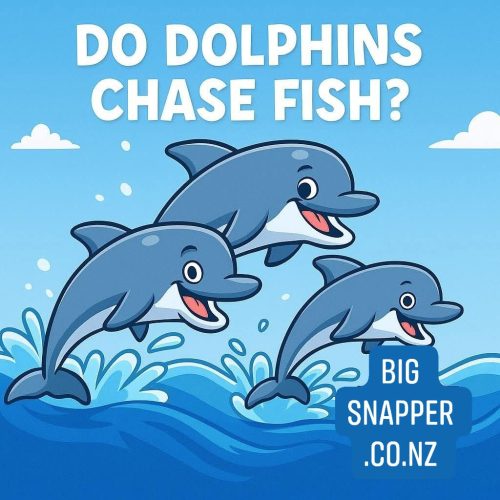

Why Dolphins Don’t Ruin the Fishing

Busting the myth, what their presence really tells you
Many anglers panic the moment dolphins show up thinking the fishing is finished. But that’s one of the biggest myths in surf fishing.
Here’s the truth:
Dolphins don’t chase fish away
They’re often working the same bait lines, rips and currents that predators like. If there’s food around, everyone is feeding.
Their presence usually means LIFE in the water
Dolphins follow baitfish, and predators follow baitfish too. If they’re cruising your zone, it’s a sign of a healthy food chain, not a dead sea.
Predator activity increases, not decreases and capitalising on stirred-up bait balls.
Only time they affect your catch?
When they’re right on top of your baits — and even then, it’s temporary. Once they move past, the zone often switches back on immediately.
So next time you see dolphins? Don’t pack up. Get excited.
It usually means you’re exactly where you need to be.
www.bigsnapper.co.nz

CASTING TECHNIQUE

WHERE MOST ANGLERS LOSE 20 METRES
If you’ve ever wondered why some anglers consistently out-cast others with the same rod, same reel, same line it almost always comes down to technique, not gear.
Here’s where most people lose distance:
1️⃣ Poor Timing
The biggest distance-killer is releasing too early or too late.
Your rod loads… but the power never transfers forward.
Fix: release at the right moment usually around the 45° forward arc.
2️⃣ Not Loading the Rod Properly
Power casting isn’t about muscle it’s about letting the rod do the work.
If your sinker isn’t loading the blank before the forward swing, you lose metres instantly.
Fix: smooth, controlled build-up from the back cast, then a clean acceleration.
3️⃣ Wrong Sinkers for the Conditions
A 5oz on a rod rated for 3–4oz won’t load properly…
A 3oz in a strong headwind dies mid-air.
Fix: match your sinker weight to your rod rating and the wind direction.
4️⃣ Line Slap & Guide Friction
Loose loops or poor line lay can cause massive resistance on the first few guides.
Fix:
• Use correct spool tension
• Keep braid tight on the spool
• Make sure your guides and tip eye are clean and smooth
5️⃣ No Follow-Through
Stopping your arms early kills momentum.
Fix: let your rod follow through naturally power flows out the tip.
6️⃣ Wrong Stance or Footwork
Casting from a stiff, locked stance = no power from your body.
Fix: step into the cast, rotate your hips, and let your whole body create momentum.
Want more distance?
A few tweaks to timing, loading, footwork and sinker choice can easily add 20–30m without upgrading any gear.
www.bigsnapper.co.nz
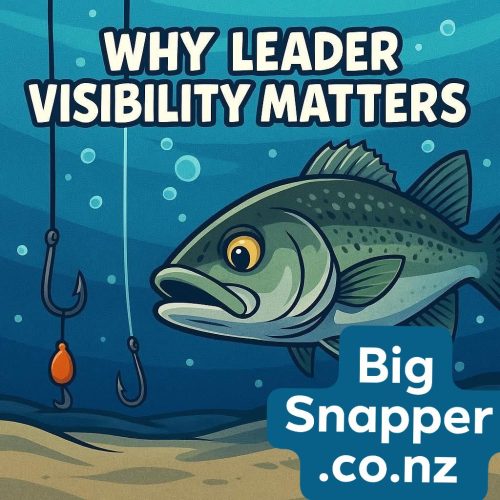
WHY LEADER VISIBILITY MATTERS

Ever wondered why one angler gets the bite and the next doesn’t? Often, it comes down to what the fish sees.
From below the surface, your leader is the first thing that can give you away.
Here’s why choosing the right thickness and type of leader makes all the difference:
1️⃣ Thinner leaders = more natural presentation
A thin leader blends into the water better, letting your bait move freely and naturally. Shy feeders are more likely to commit when they don’t spot a thick line.
2️⃣ Thicker leaders = protection and power
When fishing around reefs, rocks, or toothy species, thicker leaders give you abrasion resistance and the confidence to pull hard but can be more visible in clear water.

3️⃣ Why fluorocarbon and monofilament leaders matter
Fluorocarbon has a refractive index close to water, making it nearly invisible underwater perfect for clear surf and estuaries.
Monofilament, on the other hand, offers stretch and shock absorption, helping cushion powerful runs and sudden head shakes.
Both options help disguise your setup and improve your hookup rate!
4️⃣ Match your leader to the conditions
In crystal-clear water, go lighter or use fluorocarbon.
In murky or rough conditions, step up the diameter and strength fish rely more on vibration and scent than sight.
5️⃣ Presentation is everything
It’s not just about strength it’s about how your bait looks underwater.
That’s why fluorocarbon and monofilament leaders are essential tools in every serious angler’s tackle box.
www.bigsnapper.co.nz
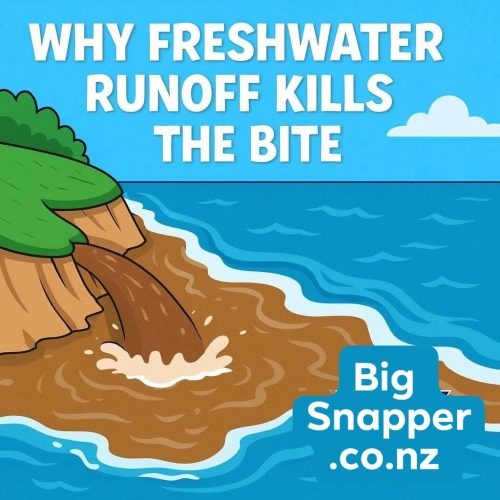

Why Freshwater Runoff Kills the Bite

Murky water • Oxygen drop • Salinity changes
After heavy rain, anglers often notice the fishing shuts down — and there’s a very real reason for it. Freshwater runoff dramatically changes the entire feeding environment.
Here’s what happens:
1. The water turns murky
Runoff pushes mud, leaves and debris into the ocean. Visibility drops, baitfish scatter, and predators rely heavily on sight so they stop actively hunting.
2. Oxygen levels fall
Sediment-filled water carries lower oxygen. When oxygen drops, fish become sluggish, stressed, and far less likely to feed.
3. Salinity suddenly changes
Saltwater species hate rapid salinity shifts. Freshwater sitting on top of seawater creates a “freshwater lid,” and many species move deeper or leave the area entirely.
4. Baitfish move out, predators follow
Once the food chain shifts, everything higher up moves too. This is why even normally productive spots can feel “dead” for days after big rains.
So if the river mouths are pumping brown water, don’t panic, just shift your strategy.
Look for cleaner water lines, deeper holes, or fish further away from the runoff plume.
www.bigsnapper.co.nz

WHEN SHOULD YOU UPGRADE YOUR BRAID?

Your braid is the lifeline between you and your fish — but even the best line doesn’t last forever. Knowing when to replace it can save fish… and your gear.
Here’s how to tell it’s time for fresh braid:
1. Faded to white
A bit of fading is normal, but when your braid loses ALL colour, it’s usually a sign the protective coating is gone.
2. Fluffy or “hairy” texture
If your braid looks fuzzy or feels rough, the fibres are breaking down. That means weak spots — and lost fish.
3. Flat or ribbon-like sections
When braid starts flattening, it doesn’t cast properly and can dig into itself under pressure.
4. Knots slipping or fraying
If your knots aren’t locking as cleanly as before, the fibres are worn out.
5. Heavy surf fishing or constant abrasion
Rocky areas, heavy sliding, sharks, and big kob sessions all destroy braid faster. High-use anglers should upgrade more often.
How long does braid last?
• Light spinning braid: 6–12 months (if used a lot)
• Heavy surf braid: 6–18 months
• Casual use: Up to 2 years if well cared for
Pro tip:
Flip your braid end-to-end every few months — the unused section becomes your fresh top-shot.

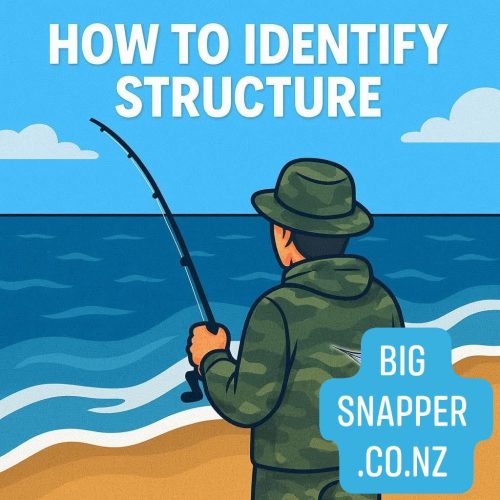
What “Structure” Really Means

Sandbanks • Rip Channels • Reefs • Gutters all explained simply
When anglers say “FIND THE STRUCTURE,” they’re not talking about buildings under the water they’re talking about the shape of the ocean floor and the features that affect how fish feed and move.
Understanding structure is one of the biggest keys to catching more fish.
Here’s a simple breakdown:
1. Sandbanks
Shallow, raised areas of sand where waves break first.
Why they matter:
• Waves dump onto sandbanks, pushing baitfish over the edge.
• Predators sit behind the bank where the water deepens, waiting for confused bait.
How to spot:
Look for waves that break far out, then reform or flatten behind the break.
2. Rip Channels (Rips)
Deeper “river-like” lanes where water pulls back out to sea.
Why they matter:
• Baitfish get trapped and pushed through the channel.
• Predators cruise rips like feeding highways.
• Rips bring oxygen and cooler water.
How to spot:
Darker, calmer-looking water between breaking waves — often with foam pulling outward.
3. Reefs
Rocky areas below the surface.
Why they matter:
• Home to smaller fish attracts bigger fish.
• Creates turbulence that offers ambush zones for predators.
• Great for targeting Blacktail, Bronze Bream, Kingfish, galjoen, and more.
How to spot:
Areas where waves constantly lift or swirl. Water often looks “boiling” or choppy.
4. Gutters
Long, deep trenches close to shore, parallel to the beach.
Why they matter:
• Prime hunting zones for predators.
• Calm appearance but deeper than the surrounding beach.
• Perfect spots on low light, early morning, and evening sessions.
How to spot:
Darker, smoother water running in a straight line inside or behind the shorebreak.
WHY STRUCTURE MATTERS
Because fish don’t swim around randomly they use structure to:
• Hunt • Hide • Rest • Ambush prey • Avoid currents • Conserve energy
If you can read structure, you can find fish even on tough days.
Structure = location.
Location = fish.
www.bigsnapper.co.nz

Big Snapper

Want to start catching and not just fishing, then check out our big snapper products

Fishing Shops

The following fishing shops listed below are ones we have visited or have been recommended due to what they offer and to their customer service given at the time of our visit.

This section will be added to and updated throughout the year as we further visit other shops around the country.

Whangarei

SaltWater Connection

Address24 Port Road, Morningside, Whangārei 0110 Phone09 438 8727
Whangarei Hunting & Fishing
Address16 Okara Drive, Whangārei 0110 Phone09 929 9713
Whangarei Buinsco
Address22 Port Road, Whangārei 0110 Phone09 438 6860

Auckland Fishing Shops

Smart Marine Mt Wellington
Address4/72 Lunn Avenue, Mount Wellington, Auckland 1072 Phone: 09 527 2860
Customer Service: Excellent
Burnsco Albany
Address17 Tawa Drive, Albany, Auckland 0632 Phone09 443 3992 
Land & Sea Store
Address36 Pollen Street, Grey Lynn, Auckland 1021 Phone: 09 360 0968
Customer Service: Excellent
Marine Deals
Address410 Rosebank Road, Avondale, Auckland 1026 Phone: 09 281 3150

Coromandel Peninsula

Hunting & Fishing Thames Address103 Kopu Road, Kopu 3578 Phone: 07 868 8260

Bubba’s Outdoor & Hire Address321 Casement Road, Whangamatā 3620 Phone: 07 865 7464 
Whitianga Sports Center Address32 Albert Street, Whitianga 3510 

Hamilton

Hamilton Smart Marine

Address3 Maui Street, Pukete, Hamilton 3200 Phone07 282 1060
Hamilton Fish City
Address265 Kahikatea Drive, Frankton, Hamilton 3204 Phone07 846 6675

Bay of Plenty

Hunting & Fishing Whakatane Address129 Commerce Street, Whakatane, Whakatāne 3120 Phone: 07 308 7528

Hunting & Fishing Rotorua Address360 Te Ngae Road, Lynmore Junction, Lynmore, Rotorua 3010 Phone: 07 349 6303 

Napier, Hastings & Gisborne

Napier Hunting & Fishing

Address170/180 Taradale Road, Pirimai, Napier 4112 Phone06 835 9016
Napier Burnsco

170-180 Taradale Road, Napier, 4112 06 843 6240

New Plymouth

New Plymouth Hunting & Fishing
Address35 Ocean View Parade, Moturoa, New Plymouth 4310 Phone06 757 2255


Wanganui

Wilsons Hunting & Fishing Outdoors
222 Victoria Ave Wanganui
06 3487679


Wellington

Capital Fishing

49 Ghuznee Street, Te Aro, Wellington 6011 04-384 5105

Hutt Valley Hunting & Fishing

8 Te Puni Street, Petone, Lower Hutt, Wellington, 5010 T: 04 589 9500

Picton & Blenheim

Blenhiem Hunting & Fishing

Address46 Main Street, Blenheim Central, Blenheim 7201 Phone03 579 1600

Christchurch

Fishermans Loft
Address359 Lincoln Road, Addington, Christchurch 8025 Phone03 338 3131
Complete Angler
AddressUnit 4/484 Cranford Street, Redwood, Christchurch 8051 Phone03 366 9885
Christchurch Hunting & Fishing

75 Clarence Street, Tower Junction, Christchurch, Canterbury, 8023 T: 03 343 0212

List a fishing shop

If you would like your fishing shop you own to be listed, or you might recommend one you use to be listed on here, then just send us 1-3 photos of the fishing shop, along with its address and a contact number.
Please make sure one of the photos shows the fishing stock area inside the shop.
email Mark: info@bigsnapper.co.nz